
Lake Forest Previous Resident Sources
Each source has one job. Deeds show ownership. Directories place listed adults at addresses, census schedules add household detail, and permits date projects, not moves. The era map shows where a gap needs a shelf check.
| Source | Years It Covers | Where Held | What It Shows |
|---|---|---|---|
| Orange County recorded property records | Electronic index; pre-1982 book, page, and instrument | RecorderWorks, Clerk-Recorder, Archives | Ownership instruments, liens, legal descriptions |
| Orange County directories including El Toro | 1926, 1929, 1931 verified; later years need shelf check | NARA inventory; Archives or State Library | Listed adults, address, occupation; reverse section only if present |
| Federal census | Through 1950 public as of 2026 | NARA and OCPL databases | Household, age, relationship, birthplace, occupation, enumeration context |
| City building files | Mostly 1991-forward; inherited county files vary | Lake Forest City Clerk or Building | Construction, alterations, inspections, named project parties |
| County-era building and planning files | Before incorporation or annexation; retention varies | OC Public Works or Archives | Permits and tract development before city custody |
| Historical newspapers | Selected 1920s-1980s; Orange County Register 1987-current | OCPL and NewsBank | Sales, notices, obituaries, local events |
| Naturalization and homestead records | 1889-1944 and 1889-1926 | California State Archives | County-level person, land, and citizenship links |
Start with the address and parcel, then choose by era. Use deeds for recent transfers, El Toro directory and census catalogs for older households, and separate city and county files for construction. Orange County Archives is the fallback when the web index stops.
Lake Forest Records by Era
Lake Forest is a late name. The community was El Toro before incorporation on December 20, 1991. Foothill Ranch and Portola Hills joined it in 2000. Current-name searches can miss older headings, tracts, permits, or notices.
Orange County began in 1889; the land was part of Rancho Cañada de Los Alisos. Postwar growth created streets after older sources. Use legal description and parcel history to bridge the record.
Lake Forest APN-First Backward Trail
Begin with the current address, not a guessed former resident. The Orange County Assessor route supplies parcel clues, and a city map can confirm geography. Keep APN and legal description together because street forms, splits, and combinations change.
- Resolve the street address to an APN and copy the legal description or tract-lot reference.
- Identify the latest owner or assessee and the parcel’s transfer clue.
- Find the latest purchase deed and note its date, number, parties, and legal description.
- Read the buyer as grantee and seller as grantor. Preserve exact names and trust wording.
- Search the seller as an earlier grantee. Test each candidate against the same APN or legal description.
- Repeat seller-to-earlier-grantee until the period or index ends.
If a name match points to a different legal description, test the parcel, tract, or map before treating it as part of the chain.
RecorderWorks Staff Fallback
RecorderWorks is a free grantor-grantee index, not a deed-image service. Modes include name, document, date, book/page, APN, legal description, and map. Name search uses last name then first name, with grantor, grantee, or both. The document number leads to a copy order.
The county’s official-record copy instructions show that handoff.
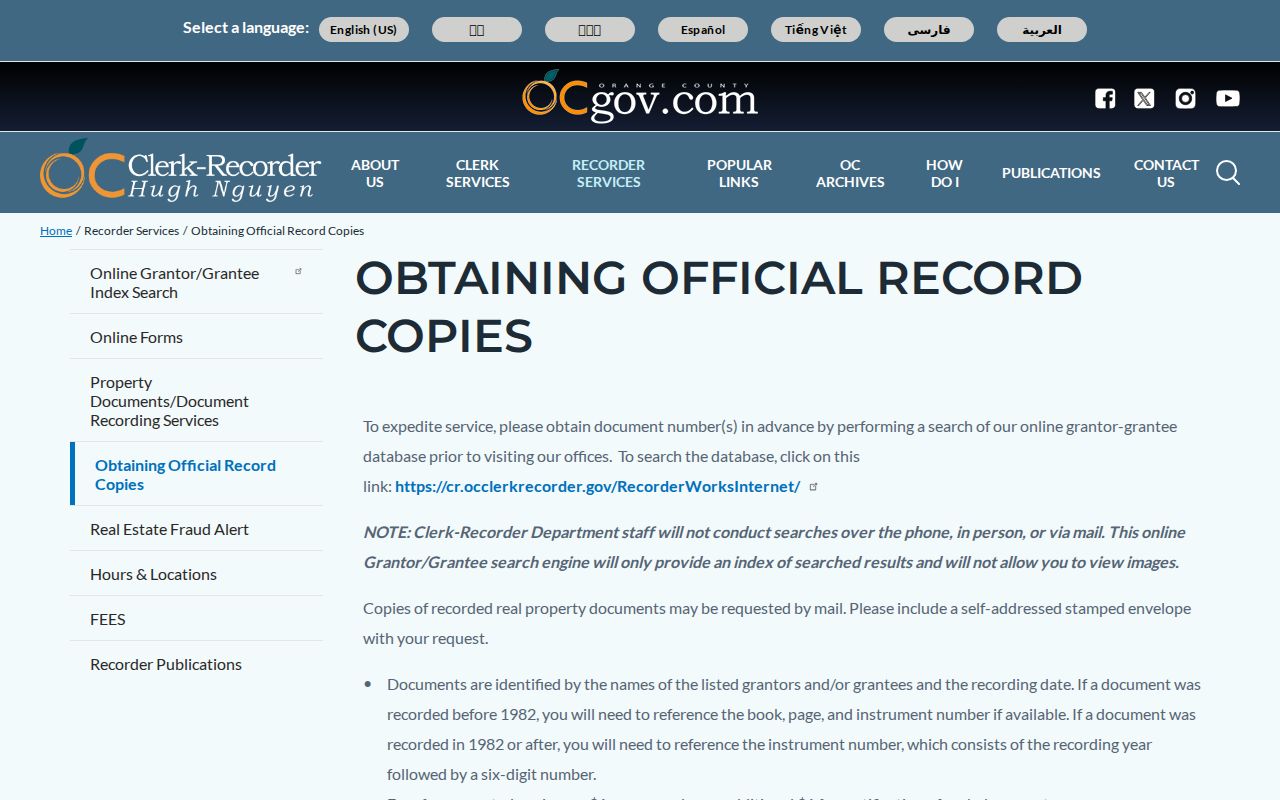
The image reflects the split between a free index and a paid copy. Copies cost $1 per page plus $1 certification per document or map. Staff will not search by phone, in person, or mail, but can interpret an order after identifiers are found. Bring the document number or older book, page, and instrument details.
| Field or mode | Type | Required | Options or format notes |
|---|---|---|---|
| Search by Name | Mode | One mode | Last name then first name, or business name |
| Party role | Choice | No | Grantor, Grantee, or Grantor/Grantee |
| Document Number | Text | Conditional | After 1982, commonly year plus six digits |
| Document Type | Dropdown | Conditional | Deeds, liens, releases, and other recorded categories |
| Recording Date | Date or date range | Conditional | Date-specific or range search |
| Book and Page | Text pair | Conditional | Especially useful before 1982 |
| APN | Text | Conditional | Assessor Parcel Number |
| Legal Description | Text | Conditional | Tract, lot, or legal-description route |
| Map | Dropdown or text | Conditional | Subdivision, parcel, annexation, survey, and other map types |
| Search and Options | Controls | Search required | Run the chosen query and set result options |
Lake Forest Deed Terms Explained
Deed indexes use short party and land terms that can hide a backward search. Read each role in one transfer, then check the land description before joining it to an earlier record. A name alone is not enough when trusts, businesses, initials, or common surnames appear.
- Grantor
- The party conveying an interest in the property, often the seller on a purchase deed.
- Grantee
- The party receiving that interest, often the buyer and the current owner on the purchase deed.
- Chain of title
- The ordered trail of recorded transfers and related instruments that connects one owner to an earlier owner.
- Legal description
- The tract, lot, parcel, map, or older land wording that identifies the land. It can remain useful when a street name or number changes.
- Criss-cross directory
- A reverse directory that may start with a street and house number, then list a subscriber or occupant if that volume has a street section.
- Enumeration district
- The area assigned to a census taker. It is a census geography, not a modern Lake Forest boundary.
These definitions separate ownership from household evidence. A grantor may sell before a directory appears, and a listed adult may never appear in the deed chain.
Lake Forest Pre-1982 Records
Older Orange County documents need a different handoff. For a pre-1982 copy order, capture book, page, and instrument information. From 1982 forward, the county commonly uses the year plus six digits. An empty result is not proof of no transfer.
When RecorderWorks stops short, ask Orange County Archives about index books or film. Preserve the chain between systems. A later deed may repeat a legal description or cite an earlier instrument, a better clue than a street name.
Note: Pre-1982 copy requests are stronger when book, page, and instrument details are supplied rather than only a modern street address.
Lake Forest Directory Census Pairing
Deeds identify title, while directories and census schedules reconstruct households. The verified run includes El Toro in 1926, 1929, and 1931. Later years need an Archives or State Library shelf check because no official source published a complete criss-cross list. The collection and entry method are part of the Lake Forest city directory collection trail.
- Choose an era-correct directory year and search El Toro as well as Lake Forest. Copy the name, initials, spouse notation, address, occupation, and abbreviations exactly.
- Check whether that volume has a reverse street section. If it does, browse the house number and nearby entries, but do not assume every volume has that feature.
- Pair the directory with the nearest public census household. Use 1920 and 1930 for the 1926 window, 1930 for 1929 and 1931, then 1940 for later continuity.
- Compare age, relationship, birthplace, occupation, address, and enumeration district. Treat a directory listing as a lead when the census handwriting or street form is unclear.
- For a disappearance, check a later directory under a spouse or adult child, then search newspapers, an obituary, probate, or a deed transfer.
As of 2026, the latest public population census is 1950 under the 72-year rule. The 1960 census is not public until 2032, so deeds, directories, newspapers, and permits bridge modern Lake Forest history.
Lake Forest Owner Versus Occupant
An owner is not automatically an occupant. The Assessor distinguishes a parcel’s situs from the mailing address for tax notices. Matching addresses can make owner occupancy plausible, but do not create a household roster. A different mailing address may reflect a trust, business, second home, or notice choice.
A homeowner’s exemption can support owner occupancy, but it can lag or change. A permit names a project party. A directory lists an adult clue. A census gives a household snapshot. Keep a separate occupancy column when a source proves ownership only. Previous residents still need a simple myth check: no field proves both.
Lake Forest 1926-1931 El Toro Window
NARA verifies Orange County directories that include El Toro for 1926, 1929, and 1931. They are countywide volumes, not Lake Forest-only books, so inspect the included-community list. That verified window is a firm prewar starting point.
The Orange County Archives holdings page identifies directories alongside historic property material, newspapers, and photographs.
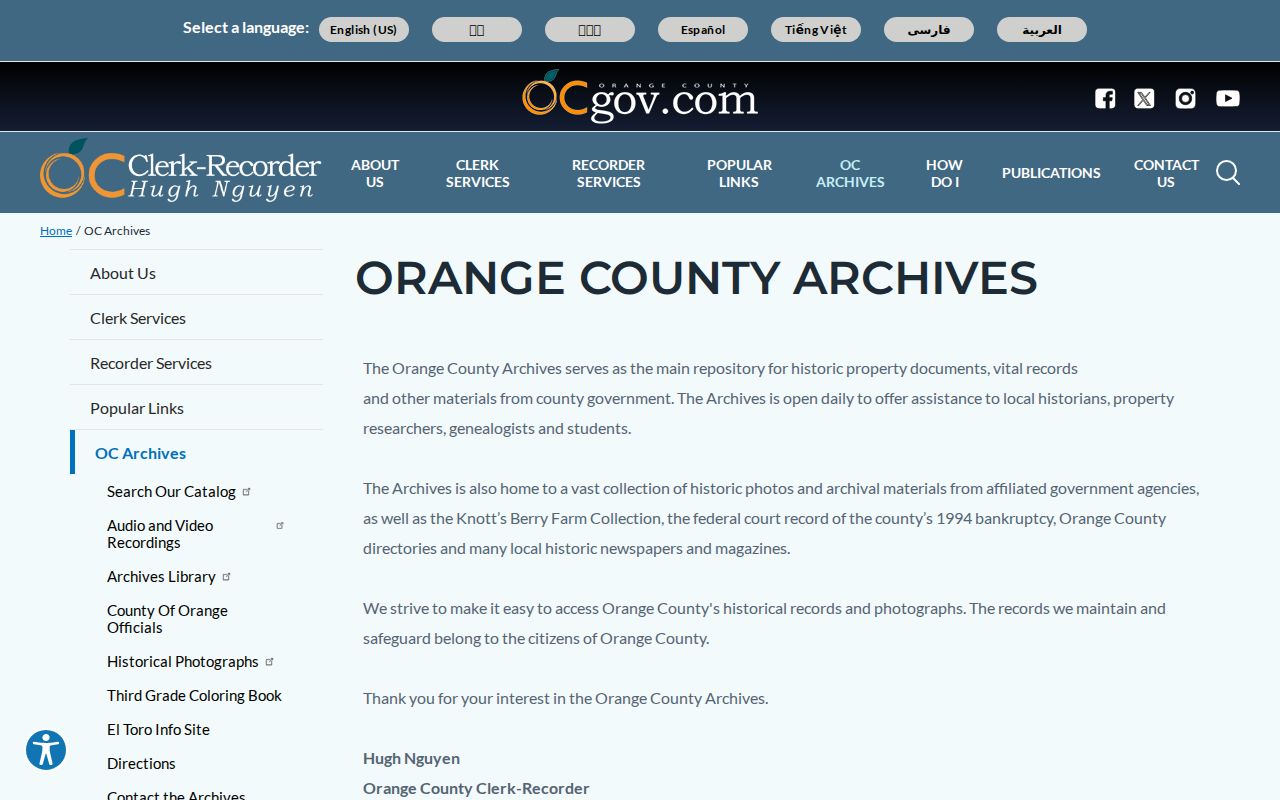
Later directory years lack a complete published run. Ask Archives for a shelf check and confirm a reverse section before a street search. The NARA directory inventory verifies the three El Toro-inclusive years.
Lake Forest Jurisdiction Records
Custody follows jurisdiction and record type. City files are mostly 1991-forward because Lake Forest incorporated on December 20, 1991. Foothill Ranch and Portola Hills were county-era communities before the 2000 annexation, so older permits may remain county records. Deeds remain Orange County records through every boundary change.
Search Lake Forest, El Toro, Foothill Ranch, and Portola Hills. Confirm the present parcel in a city map, then ask whether a historic permit was inherited by the city or retained by the county. This is a custody question, not a claim that a file disappeared.
The Foothill Ranch Library branch information is a useful reminder that an annexed community can keep its older local name inside a modern city system.
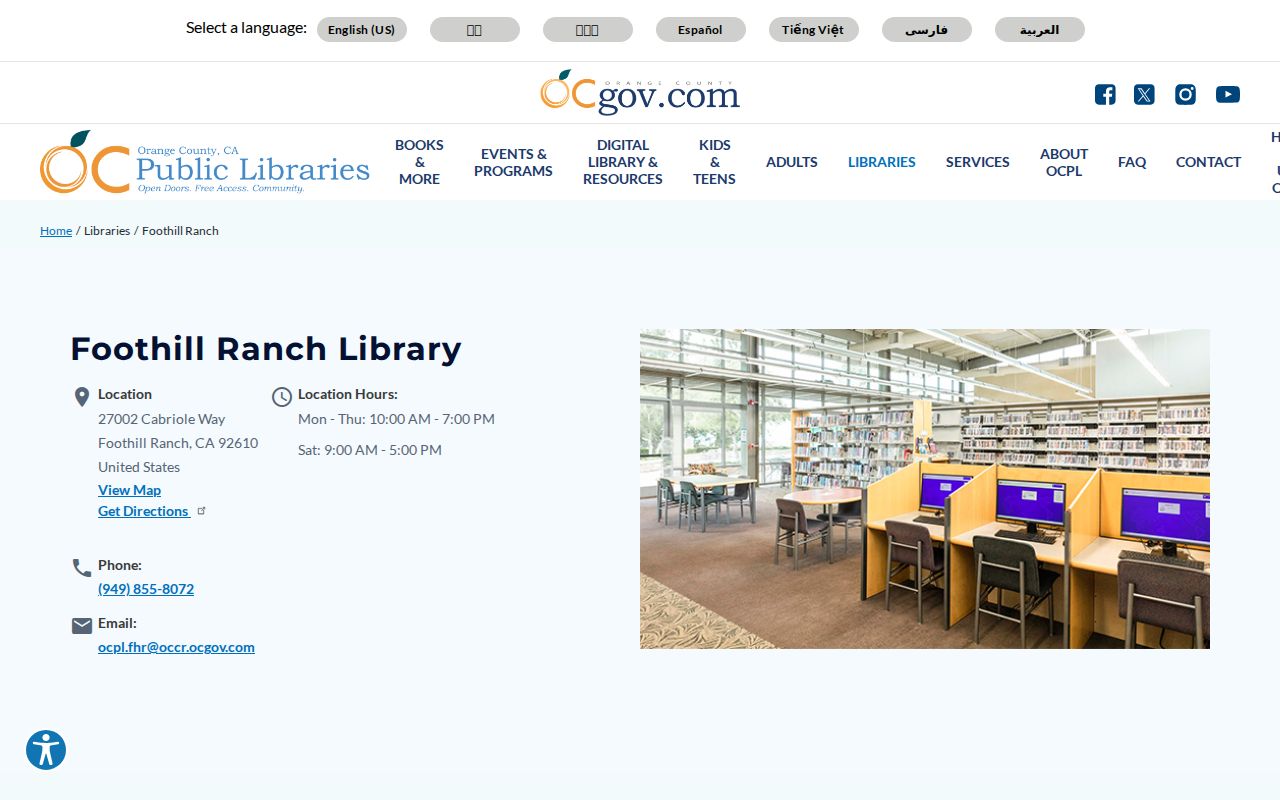
The branch image connects the current Lake Forest geography to the Foothill Ranch name that may appear in older directories, newspapers, and county files.
Lake Forest Sanborn Research Gap
Sanborn fire-insurance coverage for Lake Forest or El Toro was not verified in the research run, and no official source supplied a Lake Forest-specific house-history guide. That absence should stay visible. Do not invent a local sheet series or use a generic map claim to fill a gap.
Use tract and subdivision maps, historic aerial or topographic maps, recorded deeds, permits, Orange County Archives photographs, and the UCI Orange County Regional History Collection instead. These sources fit Lake Forest’s limited pre-1940 urban fabric and its later master-planned growth better than an assumed Sanborn sequence.
Lake Forest Past Resident Endpoints
Permits date construction, additions, inspections, and projects, but not a move-in or move-out date. An obituary may identify a final residence and survivors. Probate may identify heirs or addresses. A deed can test an estate transfer.
Newspapers can bridge a missing directory with a sale notice, obituary, or address clue. Treat each item by what it says. A same surname is not proof of kinship, and a final residence is not proof of every earlier address.
For the current parcel-to-owner pass, the Lake Forest by-address records workflow keeps the present APN and legal description separate from the historical household trail.
Lawful house history. Previous-resident research in Lake Forest belongs to family history, genealogy, estate work, property history, and personal curiosity. Do not use a record to stalk, harass, track, or harm a living person.